
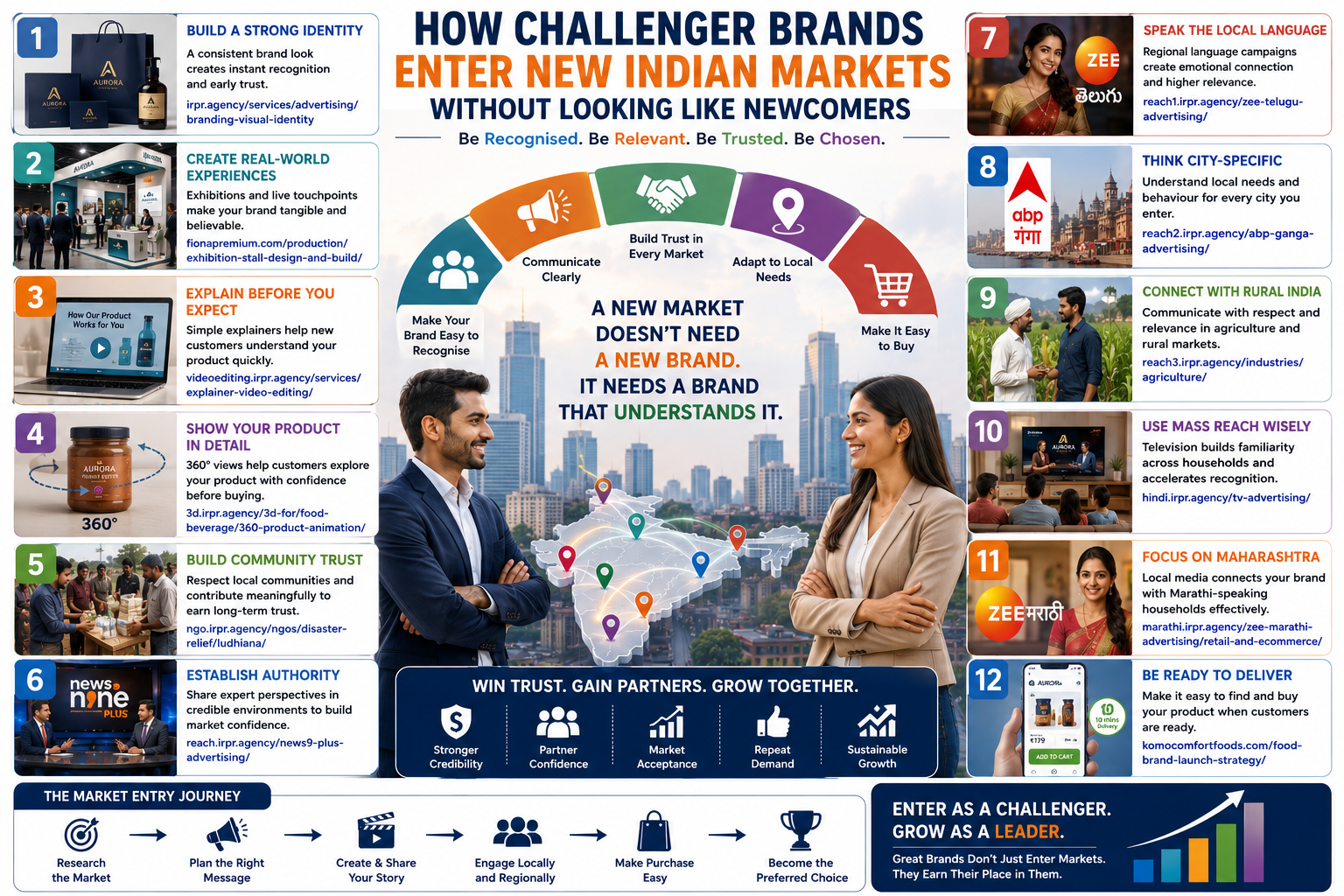
Entering a new market is one of the most exciting moments for a growing business.
It may mean opening in a new city, expanding into another state, launching a new category, entering a regional-language market, finding distributors, reaching retailers, or moving from a small customer base into a much larger audience.
But expansion comes with a challenge that many brands underestimate.
The new market does not know you yet.
Your team may know the product is good. Your existing customers may trust you. Your original city may already associate the company with quality, service, innovation, affordability or reliability. But in a new city, customers do not have that history.
They have no reason to assume the product is established.
They may not know whether it is safe, useful, premium, relevant, easy to buy or worth trying. They may not know whether the company understands their needs. They may not know whether the brand will still be around in six months.
This is the credibility gap.
The brands that cross it successfully do not try to solve everything with one big launch advertisement. They build confidence gradually. They make the brand easy to recognise, easy to understand, easy to talk about, easy to find and easy to buy.
A strong market-entry strategy does not make a company look like it is desperately trying to become visible.
It makes the company feel like it already belongs there.
The Brand Must Look Familiar Before It Is Actually Familiar
A customer often makes a quick judgement about a new brand before reading a single line of copy.
They notice the logo, packaging, typography, colour system, website, ad design, product photography, social-media content and retail presence. These visual signals create a first impression of whether a company feels organised, reliable, premium, affordable, modern or unfinished.
That first impression matters because most new-market customers are comparing an unfamiliar brand against names they already recognise.
A brand entering a new city should not look different across every channel. The product pack should feel connected to the advertisement. The website should feel connected to the social-media content. The retail display should feel connected to the event environment. The founder presentation should feel connected to the sales deck.
A coherent branding and visual identity system helps create that consistency. It gives the business a recognisable language that can travel from one city to another without losing its personality.
This does not mean every company needs to look expensive or overly polished.
It means the business should look intentional.
A value-focused product should still look clear and trustworthy. A regional brand should still look confident. A premium service should still feel accessible. A technology company should still explain itself simply.
When the identity is strong, customers begin recognising the brand before they know its full story. That recognition creates the first layer of confidence.
People Believe What They Can Experience
A market-entry campaign becomes more believable when customers can see the business operating in the real world.
Digital ads can create awareness quickly, but physical experiences make a brand feel tangible. People can see the products, meet the team, speak to sales representatives, watch demonstrations, inspect packaging, ask questions and understand whether the business feels serious.
For B2B brands, FMCG companies, industrial businesses, technology firms, real-estate developers and consumer-product companies, exhibitions remain useful because they bring decision-makers into the same environment.
A well-designed exhibition stall and experiential build can help a company create a stronger presence at trade shows, expos, conferences and product launches.
The objective should not be to create the largest stall in the venue.
It should be to make the right people stop.
A visitor should quickly understand what the brand does, why the product matters and what conversation they should have with the team. The space should give customers a reason to stay longer than a few seconds.
For a new entrant, the physical environment acts as proof. It tells distributors, buyers, partners, retailers and customers that the company has prepared for the market. It shows that the product is not only an online idea or a temporary launch campaign.
It is something real.
A New Product Needs Explanation Before It Needs More Attention
One of the biggest mistakes companies make during expansion is assuming customers understand the product as clearly as the internal team does.
The founder understands the innovation. The sales team understands the features. The product team understands the technical difference. But the customer may only see a new name, a new pack, a new service or an unfamiliar claim.
That gap can slow down adoption.
A new brand may need to explain why the product exists, what problem it solves, how it works, who it is for and what makes it different from the existing option customers already use.
This is especially important for technology products, consumer-health brands, industrial solutions, SaaS companies, financial products, education services, premium consumer goods and new food categories.
A clear explainer video editing approach can turn a complicated pitch into a simple story.
The strongest explainers do not overload the viewer with features. They focus on one useful outcome. They make the customer feel smarter after watching.
A software platform may show how it reduces a business task. A consumer product may demonstrate a daily use case. A healthcare service may explain what happens after booking. A B2B company may show how a process becomes safer, faster or more efficient.
When customers understand the category, they become more open to trying the brand.
Product Discovery Is Now Happening on Small Screens
For many brands, the first product interaction is no longer inside a store.
It happens through a product thumbnail, a marketplace listing, a quick-commerce card, a social-media post, a website page or a mobile advertisement.
This creates a new challenge.
The product needs to look clear and convincing even when the customer sees it at a very small size.
A food, beverage, beauty, personal-care, wellness or household product may have a great pack design in real life but still look weak online. The colours may not stand out. The label may not be readable. The product may not communicate its category clearly. Customers may not understand the variant, size, flavour or key benefit.
Interactive visual formats can reduce that uncertainty.
A detailed 360-degree product animation for food and beverage brands can help customers inspect a product more closely before they decide to buy it.
This is useful when a product needs to show multiple sides, packaging details, ingredient claims, finishing quality, lid design, variant differences or premium visual appeal.
The value is not only aesthetic.
A customer who can inspect a product with more confidence is less likely to hesitate at the final moment.
For a new brand, that can make the difference between curiosity and trial.
Local Trust Cannot Be Borrowed Overnight
When a business enters a new market, it is also entering a community.
That community may have its own concerns, priorities, local challenges, language preferences, economic realities and expectations from brands operating in the area.
A company cannot build real local trust simply by adding the name of a city to an advertisement.
It needs to show that it understands where it is operating.
This can include supporting local entrepreneurship, creating employment, working with local distributors, improving access to useful products, supporting education, contributing to health awareness, partnering with community initiatives or showing responsible behaviour during difficult moments.
The ethical storytelling principles used in disaster-relief communication offer an important lesson for commercial brands as well.
When communities are going through difficulty, brands should not treat the moment as a publicity opportunity. They should lead with usefulness, dignity and real contribution. Communication should reflect genuine action rather than exaggerated claims.
Customers remember how businesses behave when conditions are difficult.
A company that supports people meaningfully earns a level of goodwill that cannot be generated through a paid campaign alone.
Authority Changes How a New Brand Is Evaluated
A new brand is often judged more harshly than an established one.
Customers may ask whether the company is credible. Partners may question whether it has long-term potential. Investors may want proof that the market understands the business. Distributors may wonder whether demand will exist outside the original city.
This is why authority-led communication can make a difference.
A founder interview, expert discussion, thought-leadership feature, business conversation or industry panel can help a company show that it understands the category beyond the product itself.
A relevant News9 Plus advertising opportunity can support brands that need a more serious environment for business conversations, leadership messaging, innovation stories or category education.
The purpose is not to make a company sound more corporate than it really is.
It is to give the market useful context.
A founder can explain why the business was started. A technical leader can discuss a problem affecting the industry. A product specialist can explain a shift in customer behaviour. A company can share a useful point of view rather than simply repeating an offer.
When people learn something valuable from a brand, they begin trusting its expertise.
Expansion Needs Language, Not Just Geography
Entering a new state is not the same as entering a new pin code.
Language, culture, media habits, family behaviour, retail patterns, price sensitivity and local trust signals can change the way customers react to a brand.
A campaign that performs well in Maharashtra may need a different tone in Telangana or Andhra Pradesh. A product message that works in English may feel distant when customers prefer Telugu. A brand entering Hyderabad, Vijayawada, Visakhapatnam or Tirupati may need more than a translated advertisement.
It needs local relevance.
A focused Zee Telugu advertising plan can help brands think about communicating with Telugu-speaking households through a regional entertainment environment.
The product promise can remain consistent, but the communication should feel natural to the audience.
A family-focused product may need warmth and everyday storytelling. A new retail brand may need regional familiarity. A healthcare product may need trust and clarity. A financial service may need practical language. A food brand may need to understand local taste preferences, family routines and cultural occasions.
The strongest regional campaigns do not speak at the audience.
They speak with the audience.
Hindi Markets Require City-Level Thinking
Hindi-speaking markets are often grouped together as one large opportunity.
But cities such as Lucknow, Kanpur, Agra, Varanasi, Prayagraj, Dehradun, Meerut, Noida, Gurugram and Delhi NCR can behave very differently.
A campaign that creates awareness in one market may not create the same response in another. The product category may be familiar in one city and new in another. One market may respond better to family-led messaging, while another may be influenced by price, local availability, quality or credibility.
For businesses expanding across Uttar Pradesh and Uttarakhand, an ABP Ganga advertising strategy can help create visibility in a regional Hindi news environment.
The value of this kind of media is not simply reach.
It is relevance.
Customers often respond more strongly when the brand appears within the kind of information environment they already follow. A regional business announcement, retail launch, healthcare campaign, financial product, education offering or local service can feel more trustworthy when it is communicated through familiar local-language channels.
The brand should still maintain a consistent identity.
But the message should feel connected to the market it is trying to enter.
Rural and Agricultural Markets Need Respectful Communication
Agriculture, agri-inputs, rural commerce, farm technology, food processing, equipment, irrigation, crop solutions and rural finance are not categories that can be marketed through generic urban messaging.
Customers in these sectors often make decisions based on practicality, trust, local knowledge, weather patterns, crop cycles, dealer relationships, product performance and community recommendations.
A strong agriculture and agri-inputs advertising approach can help businesses think about how to communicate with agricultural audiences in a way that feels useful rather than distant.
For companies serving rural markets, the product story should answer practical questions.
How does it work? How does it improve outcomes? Is it available locally? Who can provide support? How does it compare with what the customer already uses? Is there proof from other people in a similar environment?
The most effective communication often combines local language, retailer support, field demonstrations, expert voices, farmer stories and visible availability.
Trust in agricultural markets is rarely created by a single advertisement.
It is built through consistency and proof.
Mass Reach Still Has a Role in Building Familiarity
Digital campaigns are useful for targeting and conversion, but large-scale media can still create a different kind of advantage.
It can make a brand name feel familiar before customers actively start looking for the product.
For businesses targeting Hindi-speaking households across multiple cities, a structured Hindi television advertising strategy can help build broad recognition through entertainment, news and family-viewing environments.
This is particularly useful for consumer brands, education companies, healthcare services, retail chains, personal-care products, food brands, appliances, finance products and new household categories.
The goal is not always an immediate sale.
Sometimes the goal is to make the customer remember the brand name before the moment of need arrives.
A person may see the brand on television, later notice it in a local store, encounter it on a marketplace app and finally recognise it when they are ready to purchase.
That repeated exposure creates confidence.
And confidence often shortens the buying journey.
Maharashtra Needs Retail Communication That Feels Local
Maharashtra is one of India’s most important markets for retail, e-commerce, consumer products, food brands, beauty, fashion, wellness and household categories.
But it is not a single audience.
Mumbai, Pune, Nashik, Nagpur, Thane, Navi Mumbai, Kolhapur and Chhatrapati Sambhajinagar each have different retail behaviours, media preferences and household decision-making patterns.
For businesses targeting online and offline shoppers in Maharashtra, retail and e-commerce advertising on Zee Marathi can support stronger regional familiarity.
The value of Marathi communication is not limited to translation.
It creates emotional proximity.
A customer is more likely to trust a brand that feels like it understands the home, the market, the festival calendar, the family routine and the language of the people it wants to serve.
A national campaign may create awareness.
A regional campaign helps the brand feel closer.
The Product Must Be Ready When Demand Arrives
The biggest mistake a growing consumer brand can make is creating awareness before preparing for the purchase moment.
A customer may see an advertisement, watch a product video, hear a recommendation, notice a campaign in their city and finally decide to buy.
But if the product listing is unclear, the pack image is weak, the offer is confusing, the category placement is wrong or the item is unavailable, the campaign loses value at the last step.
For food and FMCG businesses, launch readiness includes much more than the product itself.
It includes the packaging, marketplace visuals, product titles, pricing, bundles, quick-commerce listing, retail support, city availability and customer journey after the first order.
A focused food brand launch strategy for quick commerce and D2C can help consumer brands connect positioning, packaging, listings, launch campaigns and multi-city expansion.
The customer does not separate marketing from availability.
They only know whether the product was easy to find and easy to buy.
A strong market-entry campaign creates curiosity.
A strong commerce system converts that curiosity into revenue.
Final Thoughts
The strongest challenger brands do not try to look like the biggest company in the market.
They try to look like the most prepared.
They build a recognisable identity. They create physical proof. They explain unfamiliar products clearly. They make the product easier to inspect. They communicate respectfully with local communities. They show expertise through credible conversations. They adapt to regional languages. They respect city-level differences. They create local familiarity before asking for trust.
And when the customer is finally ready to buy, they make the purchase simple.
That is how a new brand stops looking like a newcomer.
It becomes a business people are already prepared to choose.
Leave a Reply